
Malacca is one of those places people keep calling a day trip, which feels slightly unfair once you actually start walking around.
Yes, it is close enough to Kuala Lumpur for a short escape. Depending on traffic, the drive can hover around the two hour drive mark, while buses arrive at Melaka Sentral from KL in just a few hours. If you are already planning a longer Malaysia trip, you can easily pair it with our guide to things to do in Kuala Lumpur.
But visiting Melaka is very different from attacking a big city itinerary. Much of the historic Malacca City core is compact, and several major sights sit within walking distance of one another.
The best things to do in Malacca are not necessarily about collecting attractions. A lot of the fun comes from what happens between them.
You walk past a temple, find a cafe, take a wrong turn, discover some street art, buy something unnecessary, then somehow end up eating again.
Jonker Street Night Market for Street Food, Local Food and All the Food

If your Melaka trip lands on a weekend, Jonker Street Night Market is the obvious place to begin.
During the day, Jonker Street is lined with antique stores, souvenir shops, old coffee shops, cafes, small museums and traditional buildings. Come Friday, Saturday or Sunday evening, Jonker Walk transforms into a night market from around 6pm to midnight.
Is it crowded? Yes.
Touristy? Obviously.
Still worth doing? Also yes.
The fun is partly in surrendering to it. There are souvenir stalls, snacks, queues, music and enough street food to completely ruin whatever sensible dinner plan you arrived with.
The strategic mistake is coming here full. Jonker Street does not care that you had a late lunch.
Melaka’s famous chicken rice balls are one obvious stop. The rice is cooked with chicken stock, shaped into compact rice balls, then eaten with chicken and chilli. Are the balls functionally necessary? Probably not. Do they make eating chicken rice in Melaka feel more specific to the place? Absolutely.
Then there is cendol: shaved ice, pandan jelly, coconut milk and dark palm sugar syrup. This is where gula Melaka earns its name, giving the dessert a caramel-like sweetness that is much deeper than plain sugar.
Do not stop at snacks either. Melaka is one of Malaysia’s major centres for Nyonya food, and Nyonya cuisine brings together Chinese and Malay influences through ingredients such as coconut milk, spices, fermented condiments and aromatic herbs.
There are many restaurants around Jonker and the surrounding side streets, so if you want local food rather than just grazing, sit down for a proper Peranakan meal. You will also find guided tours and food walks operating around the area, but honestly, locating good food here is not an advanced navigational exercise.
Follow the queue. Then join another one.
Dutch Square, Christ Church Melaka and the Fun Things in Between

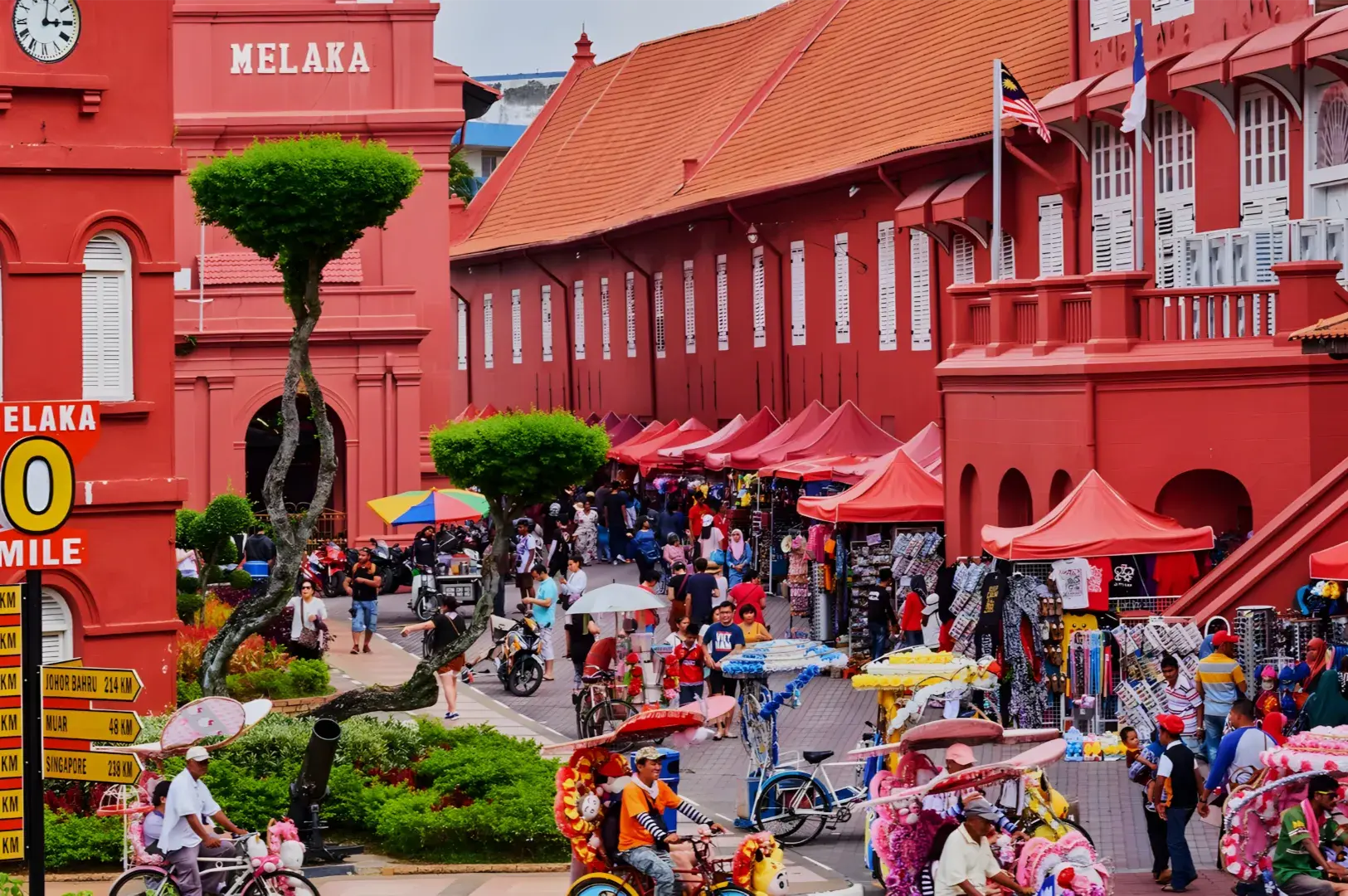
You know you have reached Dutch Square when everything suddenly turns aggressively red.
Christ Church Melaka, the Stadthuys and Tan Beng Swee Clock Tower (as known as the red clock tower) form one of Melaka’s most recognisable clusters of historic buildings. Christ Church was completed in 1753 and is regarded as Malaysia’s oldest Protestant church.
It is also only a short walk from Jonker Street, so there is almost no excuse to skip it on a first visit. The square is photogenic enough on its own, but the trishaws are what prevent anybody from taking the history too seriously.
Today’s Melaka trishaws are less quiet transport and more moving entertainment systems. Expect LEDs, flowers, cartoon themes, superheroes and yes, Hello Kitty, often accompanied by music that announces your arrival several seconds before the trishaw itself. Most are now used by tourists rather than as everyday transport, with routes looping around iconic landmarks in the heritage district.
Historically important Dutch architecture in front, illuminated Hello Kitty mobile disco behind. Melaka contains multitudes.
It is actually a fun way to see part of the centre if your feet are tired, particularly after dark when the colorful lights come on.
Just agree on the route and price before getting in. As a tourist attraction, it is completely unsubtle.
That is part of the charm.
A Famosa Fort, St Paul’s and the Sultanate Palace History Walk

If you only do one proper heritage walk in Melaka City, make it this one.
Start at A Famosa Fort, built by the Portuguese in 1511 after they captured Melaka. Most of the original fortress disappeared long ago, so what visitors mainly see today is the surviving Porta de Santiago gateway. It remains one of the oldest surviving European architectural remnants in this part of Asia.
It is smaller than first-timers sometimes expect. Nobody tells you that in the photos.
From there, walk uphill towards St Paul’s Church. The chapel was originally built in 1521 by Portuguese captain Duarte Coelho, later passing through different uses under Dutch rule. Today, it is a roofless ruin filled with old tombstones and the kind of weathered stone walls that encourage everybody to suddenly take artistic photographs.
The climb is not difficult, but Melaka heat can make twelve stairs feel like character development. So remember to wear proper shoes.
After St Paul’s, continue towards the Malacca Sultanate Palace Museum. The wooden sultanate palace is a reconstruction based on descriptions associated with the Melaka Sultanate rather than an original 15th-century building that somehow survived every colonial power that followed.
Inside, this cultural museum shifts the story away from Portuguese and Dutch rule towards the Malay court, with displays on clothing, weapons, court customs and stories associated with figures such as Hang Tuah.
If you only see A Famosa and St Paul’s, you get a very European version of Melaka’s history. The palace helps put the Malay sultanate back into the picture.
It is an important correction, especially when so many places to visit in Malacca focus heavily on what happened after Europeans arrived.
The Melaka River Cruise Gives Your Feet a Break and the Street Art a Better Angle

The Malacca River once mattered because of trade. Today, one of the easiest ways to experience it is to sit down and let somebody else do the moving.
The Melaka River Cruise takes roughly 45 minutes over a nine-kilometre round trip, with boats passing Jonker, Kampung Morten, old shophouses, bridges, mosques, murals and stretches of colourful riverside development. Cruises depart from the Spice Garden/Taman Rempah and riverfront Quayside area, with services operating daily.
This is one of those attractions where timing changes the experience. Go during daylight and you see the architecture and street art more clearly. Go after sunset and the bridges, buildings and riverbank switch into full colorful lights mode.
We prefer the transition between the two.
Walking beside the river is more intimate, especially as you wander towards quieter stretches away from Jonker, but the river cruise gives you the overall shape of the city without another hour on your feet.
Is it touristy? You are sitting on a sightseeing boat. Of course it is touristy.
That does not mean it is bad. In fact, if you have spent most of the day walking, this may suddenly become your favourite historical activity.
Harmony Street Shows Why Melaka Malaysia Is More Than Colonial Buildings

One of the most interesting stretches in Melaka Malaysia is not particularly grand. It is simply a street where several communities built places of worship close to one another.
Around Jalan Tokong and Jalan Tukang Emas, Harmony Street links Cheng Hoon Teng Temple, Kampung Kling Mosque and Sri Poyatha Moorthi Temple within a very manageable walk.
Cheng Hoon Teng is generally regarded as Malaysia’s oldest functioning Chinese temple, dating to the mid-17th century. You will sometimes see it lazily described as simply the country’s oldest temple, but “oldest functioning Chinese temple” is more accurate. Take your time with the timber work, roof decoration and intricate carvings rather than simply walking in, taking one photo and leaving.
A short distance away, Kampung Kling Mosque reflects Malay, Sumatran, Chinese and Indian architectural influences, while Sri Poyatha Moorthi Temple is among Malaysia’s oldest functioning Hindu temples.
What we like about this stretch is that it makes Melaka’s multicultural history feel much less abstract.
Local people still use these places for worship. They are not religious buildings preserved solely because tourists arrived.
That also means behaving accordingly. Dress modestly, follow footwear rules, keep voices down and accept that access can change during prayers or ceremonies.
Melaka’s story is often reduced to Malay, Portuguese and Dutch history. Harmony Street reminds you there are Chinese, Indian and Muslim trading histories sitting in the same few blocks too.
The Samudera Maritime Museum and Menara Taming Sari Explain Melaka From Two Heights

The Samudera Maritime Museum is very difficult to miss because somebody has essentially parked a giant wooden ship beside the road. The museum sits within a replica of the Portuguese vessel Flor de La Mar and uses maps, models and displays to explain Melaka’s importance as a trading port through the Sultanate and subsequent Portuguese, Dutch and British periods.
From outside, it can look slightly theme-park-ish.
Inside, the story is useful.
The Maritime Museum explains why so many empires wanted Melaka in the first place.
After looking at trade routes on a map, you can then go almost completely in the opposite direction and see the city from above at Menara Taming Sari.
The rotating glass cabin rises to around 80 metres and gives passengers a 360-degree panorama during a ride of roughly seven minutes. From the top, you can pick out St Paul’s Hill, the ship-shaped museum, the Melaka River, the Straits Mosque and the wider city.
Current hours run from 9am to 10pm on weekdays and until 11pm on weekends and public holidays. The ride itself is short. And that is actually a positive. You get the view without turning observation into a full afternoon activity.
If you like history, do the museum. If you like photographs, do Taming Sari.
If you are like us and apparently incapable of choosing, do both.
Melaka Straits Mosque Is One of the Best Sunset Stops

The Melaka Straits Mosque requires a small detour away from the tight heritage core, but this is one stop we would not try to squeeze into the middle of a walking route.
Take a car.
The mosque stands on Pulau Melaka beside the Strait of Malacca, extending over the water so that at high tide it appears to float. The blue-and-gold dome, minaret and open sea make it one of the most photographed modern landmarks in the city.
Most people visit around sunset and that is exactly when we would go.
Arrive while there is still daylight, walk around the exterior respectfully, then stay while the colour of the sky changes and the building begins to light up.
The photo is nice. Watching the whole scene change over half an hour is better.
This is an active mosque, not a set built for Instagram. Dress modestly, follow instructions about shoes and clothing, and remember that prayer takes priority over sightseeing.
There is no need to overcomplicate this stop.
Come late afternoon. Do less. Look at the sea.
Portuguese Settlement Turns Heritage Into Dinner

By this stage, another museum display might finish us off. This is where the Portuguese Settlement becomes useful.
Located around Ujong Pasir, the area is associated with Melaka’s Portuguese-Eurasian Kristang community, whose history stretches back to Portuguese rule. The community retains distinctive food traditions and a Portuguese-derived creole language, while Portuguese Square and the surrounding restaurants remain major visitor draws.
This is where heritage becomes less about plaques and more about dinner.
Seafood is one obvious attraction, alongside Kristang cooking shaped by European and local influences. The flavours can be bolder than people expect, particularly in dishes involving chilli, spices and seafood.
What matters more is that this is a living community rather than a recreated historical quarter.
After a full day of museums and monuments, learning about Melaka while somebody puts dinner on the table feels like an excellent system.
Take your time here rather than treating it as one final checklist item.
If You Still Have Energy, Add Klebang Beach

Klebang Beach is more of an optional detour than an essential first-trip stop.
If you have a car and extra time, head out for the open coastal space and pair it with the famous Klebang coconut shake. It is a pleasant change after a dense day in the heritage centre, especially if you want somewhere less structured.
For a short trip, though, we would not sacrifice Jonker, the river or the heritage core just to squeeze it in.
There is such a thing as overachieving on holiday.
What to Do in Malacca If You Only Have a Day or Two

If this is your first visit, keep it simple.
For one day, we would combine Dutch Square, A Famosa, St Paul’s, the Sultanate Palace, Jonker Street and the river. If you are staying overnight, add the Jonker Street Night Market, Menara Taming Sari and a sunset stop at the Straits Mosque.
For a food-heavy trip, prioritise all the food around Jonker, chicken rice balls, cendol with gula Melaka and a proper Nyonya meal. For a history-heavy trip, add the Maritime Museum and Harmony Street. If you have another evening, finish at the Portuguese Settlement.
The best places to visit in Malacca are close enough that you can see a lot without turning the trip into military planning.
The danger is assuming that because everything looks close on Google Maps, you should do everything.
You should not.
Leave some time for sitting down, ordering something cold and deciding where dinner is going to happen.
Leave a Reply