
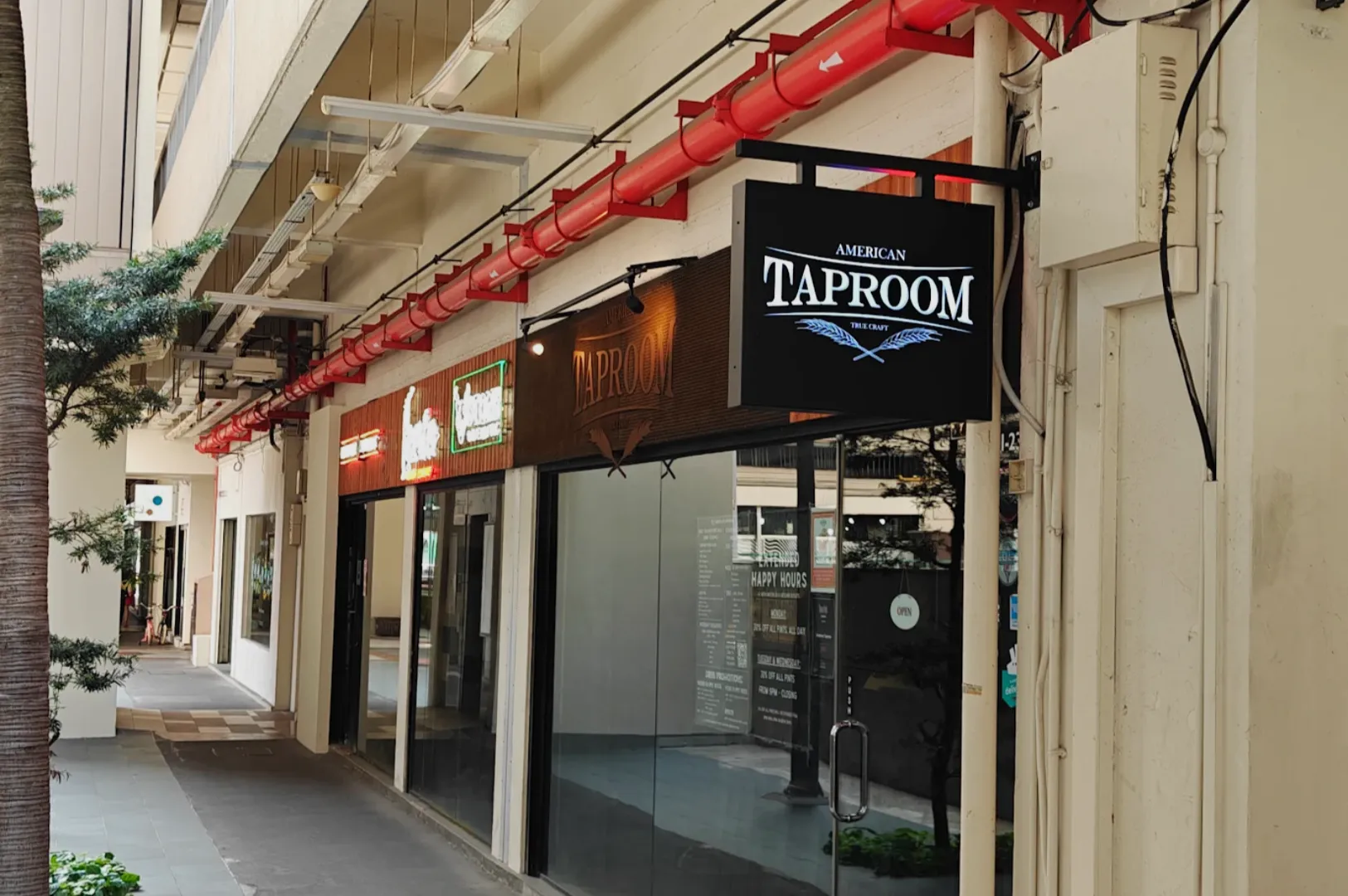
I have a problem with the name American Taproom. Not because the beer list disagrees with it, but because the three outlets disagree with each other. Walk into Waterloo Street and you get something close to what the name promises. Walk into Geylang and the story gets complicated. Walk into Stanley Street and you get a third thing entirely, dressed up for a different crowd altogether.
So when people ask me “is American Taproom good,” my honest answer is: which one.
This isn’t a knock. It’s the most interesting thing about the brand, and it’s also the reason most reviews of American Taproom end up flat. They treat it as one bar with three addresses. It isn’t. It’s three different rooms wearing the same signage, and if you don’t know which room you’re walking into, you’ll end up disappointed for reasons that have nothing to do with the beer.
I’ve spent enough evenings across all three to have opinions that don’t match each other depending on which night you ask me. That’s the point of this piece. If you want a single score out of ten, you’re in the wrong place. If you want to know which outlet actually suits you, and which one is worth your Friday night, read on.
For context, I keep a running list of craft beer bars worth knowing around Singapore, and American Taproom has sat on and off that list for a while now, depending on which branch I’m thinking about when I update it.
Three Outlets, Three Rooms

Start with Waterloo Street. This is the version most people think of when they picture American Taproom. It’s bright without trying too hard, the layout is sensible, and the crowd skews toward people who came specifically to drink beer rather than people who wandered in because it was raining. It feels purpose built, which it probably is.
Stanley Street is a different animal. It sits closer to the Tanjong Pagar nightlife belt, so the crowd arrives already a few drinks in, already loud, already looking for the next stop rather than the destination. The beer selection doesn’t change dramatically from outlet to outlet, but the energy of the room changes everything about how you experience it. Ordering a sour ale here feels almost beside the point when the table next to you is three rounds into something else entirely.
Then there’s Geylang, which I’ll get to properly in a moment because it deserves its own section. For now, just know that it’s the outlet that surprised me the most, and not in the way the neighbourhood’s reputation might suggest.
My verdict: if you’re choosing based on convenience alone, you’ll get three fairly different nights out of the same brand, so pick based on mood, not proximity.
If someone tells you “American Taproom is overrated” or “American Taproom is great,” ask them which branch they mean before you trust the opinion. I’ve had both reactions myself, sometimes in the same week.
The Tap Count Is Not the Point

Every taproom in Singapore wants to tell you how many taps they have. Thirty. Forty. Some absurd number meant to impress you before you’ve tasted a single pour. American Taproom plays this game too, and I get why. It’s an easy number to put on a chalkboard.
But here’s the thing I’ve learned after enough visits: the number of taps tells you almost nothing about whether your evening will be good. What matters is rotation, and what matters more is whether anyone behind the counter can tell you something true about what’s actually in the glass tonight, not what was in it last month.
American Taproom rotates its lines often enough that repeat visits genuinely feel different, which is more than I can say for a lot of bars claiming the same thing. I’ve had the same seat at Waterloo Street twice in one month and walked away with completely different beers both times, not because the menu changed on paper, but because what was actually pouring had shifted.
My verdict: don’t choose American Taproom for the tap count. Choose it, if you choose it, for what’s actually in rotation on the night you walk in, and ask before you assume.
This is a subtle distinction, but it’s the one that separates a taproom doing the work from a taproom doing the marketing.
The Staff Are the Real Differentiator

Here’s where American Taproom actually earns something close to a recommendation from me, and it has nothing to do with the tap wall.
The staff, at least the ones I’ve encountered across Waterloo Street and Geylang, include people with Cicerone certification, which is not a small thing in Singapore’s beer scene. For readers who don’t follow this closely, Cicerone is essentially the sommelier qualification of the beer world. It means the person pouring your drink has studied beer styles, flaws, pairing logic, and serving temperature with a rigour that most bar staff never touch.
What this means in practice is that when I’ve asked a dumb question, like why a particular IPA tasted flatter than expected, I got an actual answer instead of a shrug or a sales pitch. One staff member at Geylang walked me through the difference between a beer that was intentionally brewed low carbonation and one that had simply been sitting too long on the line, and did it without making me feel like I’d asked something stupid.
This is rare. Most taprooms in Singapore hire enthusiastic staff who know the menu. American Taproom, at its better outlets, has staff who know the subject.
My verdict: the Cicerone trained staff are the single best reason to visit American Taproom, full stop, and they’re also the reason the experience varies so much by outlet, because not every shift has one of them on the floor.
That last point matters. If you go on a night when the trained staff aren’t working, you’ll get a perfectly fine but far less interesting experience. I can’t tell you which nights that will be. Neither can you, until you ask.
Geylang Is the Interesting Story

I didn’t expect to write this section, but the Geylang outlet is genuinely the one I think about most.
Geylang carries a reputation in Singapore that has nothing to do with craft beer, and most people who know the neighbourhood by name alone would not guess that one of the city’s more serious beer bars sits inside it. That contrast alone makes it worth talking about.
What struck me on my visit wasn’t the beer, which was good but not dramatically different from what I’d had at Waterloo Street. It was the room itself. The crowd here felt more local, less tourist, less “I saw this on Instagram.” People seemed to actually know what they were drinking and why. Conversations at the next table were about brewing methods, not just which beer looked best for a photo.
There’s something almost quietly defiant about running a serious craft beer bar in a neighbourhood known for an entirely different kind of nightlife. It doesn’t lean into the contrast, doesn’t make a joke of it, just exists there, doing its own thing. I respect that more than I expected to.
My verdict: if you only have time for one outlet and you want the version of American Taproom that feels least like a formula, go to Geylang.
The Food: Honest Limitation

I need to be straight with you about the food, because this is where American Taproom shows its limits.
The food menu reads like an afterthought next to the beer program, and in practice, that’s exactly what it tastes like. Nothing I’ve ordered across any of the three outlets has been bad, but nothing has been memorable either. It’s bar food built to soak up alcohol, not food built to be remembered the next morning.
This isn’t a dealbreaker if you’re going for the beer, which you should be. But if you’re the kind of person who treats the food menu as half the reason to show up, American Taproom will leave you a little flat. I’ve eaten here enough times to say with confidence that the kitchen is not where the effort went.
My verdict: eat before you go, or treat the food as background to the beer, not a reason to visit.
For food that matches the care put into the drinks, I’d point you elsewhere in the city, though that’s a different piece for a different day.
A Note on This Series

I’ve been working through Singapore’s craft beer bars one by one for a while now, comparing notes, rewriting opinions when a second visit changes my mind, and trying to be honest even when it’s easier to just say something nice and move on. That approach matters because a good beer bar is more than a tap list: it is the welcome at the door, the condition of the pour, the music level, the food, the crowd, and whether you want to linger for one more glass. Singapore has no shortage of polished rooms, but the hidden gems are the places with a point of view—and enough care to make every visit feel like a small celebration of flavors.
This piece sits alongside a few others I’ve written recently, including a look at Craft Beer by Ki-setsu and a separate visit to Druggists, both of which approach the same basic idea, good beer, good conversation, from very different directions. American Taproom fits somewhere in between those two, closer to Ki-setsu in ambition, closer to Druggists in inconsistency.
If you’ve been following along, you’ll know I don’t rank these places against each other in any formal way. I just tell you what I found and let you decide if it matches what you’re looking for.
Who Should Go, Who Should Not

Go to American Taproom, specifically Waterloo Street or Geylang, if you care about talking to someone who actually knows beer, if you’re comfortable with a menu that changes night to night, and if you’re not relying on the kitchen to carry the evening.
Go to Stanley Street specifically if you want American Taproom as a stop on a bigger night out, not as the destination itself. Know what you’re walking into there, and you won’t be disappointed.
Skip American Taproom entirely if you’re chasing a food forward evening, or if you need the same exact beer available every single time you visit. This isn’t that kind of place, and it isn’t trying to be.
What I keep coming back to is this: American Taproom isn’t one bar pretending to be three. It’s three different answers to the same question, and the only way to know which answer works for you is to walk in and ask it yourself.
Leave a Reply