
Ask someone where to find a Melaka night market and there is a very high chance they will say Jonker Street.
Fair enough. Jonker has spent years establishing itself as the answer to practically every question involving food, shopping and what to do in Malacca after sunset. At this point, the street might as well have its own tourism department.
But there is more to Melaka’s night market scene than one crowded road selling chicken rice balls and refrigerator magnets. The interesting part begins when you realise that not every night market in Melaka exists for tourists. Some are essentially neighbourhood grocery runs with dinner attached. Others specialise in vintage clothing, local snacks and things nobody planned to buy until they saw them hanging from a rack.
That contrast is what makes exploring these markets worthwhile. Jonker is a spectacle. The smaller pasar malam offer something closer to everyday Malaysian life, where food vendors compete for attention with vegetable sellers, clothing racks and people buying household supplies.
We would not suggest skipping Jonker. That would be ridiculous. But if you have more than one evening in Malacca, there are better ways to spend it than visiting the same street twice.
Here are five markets worth building your evenings around.
Jonker Street Night Market for Street Food, Mango Smoothies and the Full Melaka Experience

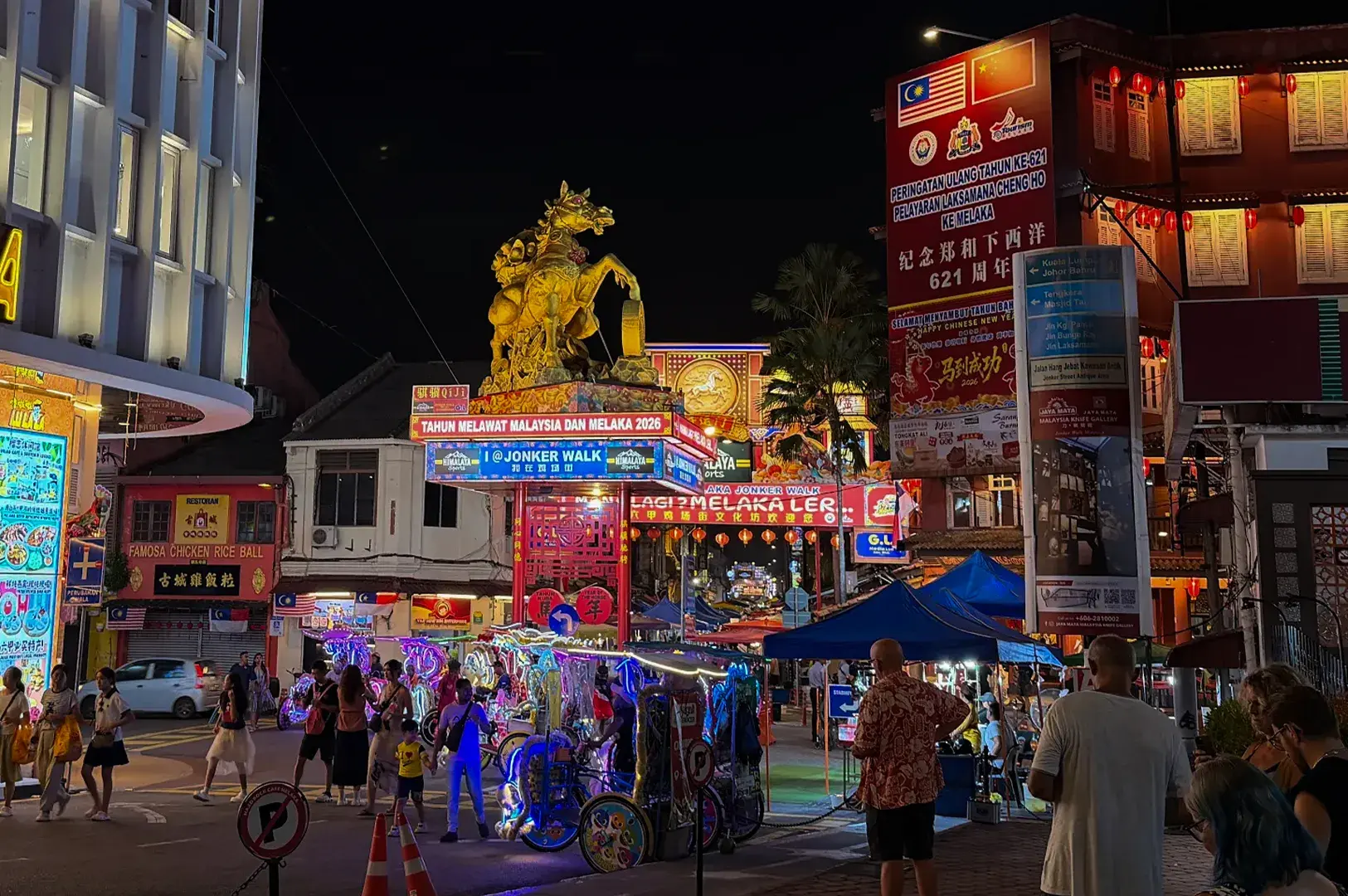
The Jonker Street Night Market, also known as the Jonker Walk Night Market, is what happens when a historic street decides it would rather become a food festival three nights a week. Every Friday, Saturday and Sunday, Jalan Hang Jebat transforms into a bustling thoroughfare lined with food stalls, pop up stalls, souvenir sellers and enough people to make walking in a straight line an ambitious goal. The red paper lanterns, old shophouses and lively atmosphere give the whole thing a certain charm, even when somebody is standing directly in front of you photographing a skewer. Jonker Walk was established in 2000, but the surrounding old town is far older. Melaka’s UNESCO-listed historic centre reflects centuries of cultural exchange involving Malay, Chinese, Indian and European communities. That is the more interesting part of Melaka’s rich heritage: the architecture may belong to different eras, but the street remains very much alive.
The obvious reason to visit is the street food. There are grilled skewers, fried oyster dishes, squid, mango smoothies, egg tarts, durian puffs and enough modern street food creations to make an entire dinner out of things served on sticks. The fried carrot cake is worth looking for. Despite its name, carrot cake contains neither orange carrots nor the sort of cake you eat at a birthday party. It is made from radish cake, chopped and fried up with egg, garlic and sometimes bean shoots into a savoury, browned mixture. It is essentially a fried up mash that tastes considerably more convincing than its appearance suggests. Freshly shucked oysters, including half shell oysters, are another possibility depending on which food vendors are operating. Then there are Melaka’s famous chicken rice balls, which are more reliably found at the established eateries around Jonker Street than at any particular temporary stall. Are rice balls functionally necessary? No. But we appreciate a city that has managed to make the shape of its rice a tourist attraction.
Dessert is where things get especially dangerous. Cendol combines shaved ice, pandan jelly, coconut milk and gula melaka, the dark palm sugar that gives the dessert its deep caramel sweetness. The sugar syrup runs through the ice rather than merely sitting on top, which is why the last few spoonfuls can be particularly rich. There are also Peranakan delicacies such as colourful Nyonya kuih, coconut-based sweets and various sugar-coated fruit snacks, sometimes with hot sugar syrup shaped into a brittle shell around the fruit. For a proper bowl of nyonya laksa, the restaurants around Jonker and its connecting streets are generally a better bet than expecting a particular market stall to be operating. The range of delicious food is simply amazing, although the existence of hundreds of snacks does not mean we are obliged to eat every one of them.
Shopping is the other half of the Jonker Street market experience. Along the main stretch, stalls sell trinkets, trendy souvenirs, clothes, small gifts and the usual tourist merchandise. The permanent shophouses offer something more distinctive, with antique trinkets, traditional crafts, batik and older businesses that have survived well beyond the arrival of souvenir keychains. If you genuinely want to find centuries old crafts or the businesses preserving those traditions, return during the day when more specialist shops are open. Street performers and live music add to the atmosphere, sometimes with traditional performances and sometimes contemporary tunes.
Jonker Walk Night Market
Address: Jalan Hang Jebat, 75200 Melaka, Malaysia
Opening Hours: Friday–Sunday, 6pm–12am
Vintage Night Market Melaka for Unique Souvenirs That Aren’t Refrigerator Magnets

After Jonker, a market devoted largely to vintage clothing feels almost suspiciously sensible. Vintage Night Market Melaka sits near the Urban Transformation Centre (UTC) on Jalan Hang Tuah, and its appeal is less about eating everything in sight and more about finding something somebody else stopped wanting. Clothing racks fill the market with old jackets, jeans, shirts, shoes, accessories and second-hand pieces of varying quality. Some look genuinely interesting. Others look like they have already survived several owners and would appreciate retirement. This is what makes vintage shopping interesting: not everything deserves rescuing, but occasionally something does. Unlike Jonker, where the shopping often revolves around tourist souvenirs, this market is a better place to hunt for unique souvenirs you might actually use.
The experience is more of a treasure trove than a carefully organised retail space. You browse, inspect stitching, check sizes and decide whether that jacket is a bargain or simply very old. Retro fashion, home décor and accessories form much of the selection, while other stalls carry newer merchandise and everyday items. Prices can be reasonable, particularly for pre-loved clothing, although there is no guarantee that every vendor shares your definition of affordable. Bargaining is possible at some stalls, but we would not recommend automatically offering 30% less than the asking price. That is not bargaining expertise. That is just arriving with a discount already decided. Inspect the item, ask politely and know when to walk away.
There are also food stalls and occasional entertainment, including music performances and DJs, although neither should be treated as a guaranteed nightly programme. The combination of clothing, contemporary tunes and people browsing well into the evening gives the place a different character from Melaka’s tourist-heavy heritage streets. We would come here specifically to shop rather than expecting an alternative to Jonker’s street food culture. If you only have one night in Melaka, Jonker is the stronger introduction. If you have already done Jonker and want something less predictable, Vintage Night Market is the more interesting detour. The market can run until 2am, but that does not mean every stall will still be operating at 1.55am.
Vintage Night Market Melaka
Address: Near Pusat Transformasi Bandar (UTC), Jalan Hang Tuah, 75300 Melaka, Malaysia
Opening Hours: Friday–Sunday, approximately 6pm–2am
Pahlawan Walk Night Market for Delicious Food Without Jonker’s Crowd Problem

There is a point during a busy Jonker evening when you realise you have spent more time navigating people than browsing stalls. Pahlawan Walk Night Market, around Plaza Mahkota on Jalan PM 4, offers a quieter alternative. It does not have the same concentration of heritage shophouses or the dramatic street setting, but it does have something that becomes increasingly attractive after an hour at Jonker: space to walk without treating every movement like an obstacle course. The market offers a great mix of clothing, accessories, small gifts, trendy souvenirs and local food, with traditional and modern elements sitting alongside one another in a much less elaborate setting.
The food options are worth browsing rather than planning around a single famous vendor. Grilled seafood, kebabs, skewers and handheld snacks have all been associated with the market, and some food sellers prepare items fresh while customers wait. Depending on the evening, you may come across oysters, including freshly prepared half shell oysters, although the selection changes with the vendors. Our preference here would be to walk the length of the market first, see what is actually cooking and then order. A busy grill tells you more than a stall displaying fifteen laminated photographs of food it may or may not be preparing particularly well. The prices are generally accessible, but we would still check before ordering seafood, especially when items are sold by weight or piece.
Pahlawan is not the market for someone seeking the full heritage spectacle. There are fewer reasons to stand around admiring the surroundings, and the shopping is fairly ordinary. But ordinary is not necessarily bad, particularly when you want an evening of browsing and eating without another enormous crowd. We would recommend Pahlawan Walk to readers who have already experienced Jonker Street Night Market and would prefer a more relaxed second evening. You are not missing a grand cultural performance by coming here. You are getting a straightforward weekend market, which is sometimes exactly what dinner needs.
Pahlawan Walk Night Market
Address: Jalan PM 4, Plaza Mahkota, 75000 Melaka, Malaysia
Opening Hours: Friday–Sunday, approximately 6pm–12am
Kampung Lapan Night Market for Local Street Food and Peranakan Delicacies

Kampung Lapan is where the night market experience becomes considerably less interested in tourists. The Tuesday pasar malam operates around Jalan Pelanduk Puteh in Taman Siantan Puri, and its purpose is straightforward: people come to buy food, fresh produce, clothes, household goods and whatever else they need before going home. There is no grand entrance, no heritage branding exercise and no reason for street performers to announce that you have arrived. Jonker is built to be seen. Kampung Lapan feels built to be used. Malay and Chinese vendors form an important part of the mix, with Indian food and other local favourites also represented. It is a good reminder that Malaysian street food culture does not exist solely to entertain visitors.
The food is what makes the detour worthwhile. Traditional Nyonya kuih are among the market’s better-known attractions, including bingka ubi, a dense cassava cake, and kuih kosui, soft steamed cakes commonly made with palm sugar and served with grated coconut. These are the sort of Peranakan delicacies that reward attention to texture rather than presentation. Good bingka ubi has a slightly chewy interior and a firmer browned surface; kuih kosui should be soft and gently springy, with coconut balancing its sweetness. Across the market, the selection can include nasi lemak, fried snacks, grilled corn, fresh fruit, sugarcane drinks and other everyday favourites. Coconut milk, pandan and gula melaka feature prominently in many traditional Malay and Nyonya sweets, although individual recipes vary. We would come here looking for local food rather than expecting every stall to sell something uniquely Melakan.
There is also a practical difference from Jonker: Kampung Lapan starts earlier and finishes much earlier. The usual schedule is Tuesday from about 4pm to 8pm, and some vendors may begin packing before closing. That makes this more of a late-afternoon food expedition than an after-dinner outing. The market can be busy with local shoppers, and parking around the residential streets may require patience. Do not expect carefully arranged tourist facilities or a guaranteed menu of famous dishes. Come hungry, carry cash and allow the stalls available that afternoon to determine what you eat. For readers who want a more everyday Melaka experience, that lack of ceremony is precisely why Kampung Lapan is worth considering.
Tuesday Pasar Malam Kampung Lapan
Address: Jalan Pelanduk Puteh, Taman Siantan Puri, 75250 Melaka, Malaysia
Opening Hours: Tuesday, approximately 4pm–8pm
Malim Jaya Night Market for Delicious Food and an Ordinary Friday Evening

Malim Jaya is not going to win a beauty contest against Jonker Street. There are no rows of historic shophouses, no red paper lanterns and no great architectural revelation waiting at the end of the road. Instead, its Friday pasar malam on Jalan Rahmat 1 offers rows of food stalls, produce sellers, clothing, household necessities and the kind of market activity that makes considerably more sense to local residents than to somebody hunting for a postcard. That is also why we would include it. Not every interesting place in Melaka needs to be historically important. Sometimes the attraction is watching an ordinary neighbourhood get on with dinner.
The food is the main reason to visit. Nasi lemak, satay and traditional kuih are among the familiar favourites associated with Malim Jaya, while peanut- and sesame-filled sweets provide something different from the endless succession of grilled snacks. You may also find seafood, fresh produce and other cooked dishes, depending on the evening’s vendors. The appeal is not one spectacular signature dish but the variety: you can buy dinner, something sweet and a bag of fruit without visiting three separate shops. Prices are generally reasonable for a neighbourhood market, though we would not assume every item is cheap simply because somebody is selling it beneath a canopy. Street food has also discovered inflation.
What we appreciate about a market like Malim Jaya is that the experience does not require much interpretation. People are buying food for their families, browsing inexpensive clothes or picking up something needed at home. Visitors are welcome, but the market is not arranged around them. It also starts winding down relatively early, with typical hours running from around 5pm to 9pm. We would aim to arrive between 5.30pm and 6.30pm, when there is still time to compare stalls and find something worth eating. Showing up ten minutes before closing and complaining about limited food choices would be a fairly impressive failure of planning.
Friday Pasar Malam Malim Jaya
Address: Jalan Rahmat 1, Taman Malim Jaya, 75250 Malim Jaya, Melaka, Malaysia
Opening Hours: Friday, approximately 5pm–9pm
Before You Go: Getting From Kuala Lumpur to a Melaka Night Market

If you are coming from Kuala Lumpur, the simplest public transport option is usually a direct bus to Melaka Sentral, followed by a local bus or Grab ride into the historic centre. Melaka City does not have a central passenger train station; the nearest practical KTM rail connections are outside the city around Pulau Sebang/Tampin.
For Jonker, walking is often easier once you reach the old town. The streets are compact, but that does not mean the crowds will cooperate. Wear comfortable shoes, arrive early and do not underestimate how slowly 300 metres can pass when everybody suddenly stops for grilled squid.
Market entry is totally free, although food, shopping and transport obviously come at an extra cost. Bring cash and carry small notes. Some vendors now accept digital payments, particularly Malaysian QR payments, but many smaller stalls still prefer cash. Even among those that accept digital payments, international visitors may find their usual banking apps less cooperative.
Also, market opening hours are not promises carved into stone. Heavy rain, public holidays and the occasional vendor deciding to take an evening off can change things.
Is Jonker Walk Still a Must Visit?

For a first trip to Melaka, yes.
Jonker remains the strongest all-round night market because it combines street food, shopping, entertainment and historic surroundings in one walkable area. It is crowded and commercial, but that does not automatically make it less worthwhile.
The other four markets serve different purposes. Vintage Night Market is better for second-hand shopping. Pahlawan Walk offers a quieter weekend alternative. Kampung Lapan and Malim Jaya are more interesting if you want to understand how neighbourhood pasar malam function beyond the tourist circuit.
If you are planning a longer trip, our guide to things to do in Malacca covers the heritage attractions, riverfront and other places worth visiting between all that eating.
Jonker is the night market you photograph. The neighbourhood pasar malam are the markets that help explain why Malaysians keep visiting night markets even when nobody is on holiday.
Both deserve a place in a proper Melaka itinerary.
Leave a Reply